The Day the Story Changed: What Betrayal Does to the Relationship You Remember
There is a moment after betrayal when the past changes.
Nothing physically moves.
The photographs are still where they were.
The holiday still happened.
The restaurant where you celebrated your anniversary still exists.
The messages are still sitting in your phone with the same timestamps.
And yet somehow, they are no longer the same memories.
You know something now that you did not know then.
And once you know it, your mind begins travelling backwards.
Was he already talking to her then?
Was that why he seemed distracted?
Was that excuse actually true?
Was I happy while something else was happening behind my back?
This is one of the cruellest parts of betrayal.
It does not stay neatly inside the moment you discovered it.
It reaches backwards and starts rewriting the story.

You begin investigating a relationship that has already happened
After someone cheats, ordinary memories can start behaving like evidence.
A late night at work.
A phone turned face down.
A sudden interest in going out without you.
A period when he seemed unusually distant.
At the time, each thing may have had a reasonable explanation.
Now they feel connected.
You begin reconstructing timelines you never wanted to build.
This can be especially difficult if, before discovering anything definite, you had already been wondering about possible signs that your boyfriend was cheating.
Suddenly your mind wants to know whether every instinct was intuition and every reassurance was a lie.
But memories rarely give us that kind of certainty.
People often remember the past through what they know in the present. New information changes the meaning we attach to old events.
That does not mean your memories were false.
It means the context around them changed.
Betrayal creates two versions of the relationship
There is the relationship you experienced.
And then there is the relationship you discover existed alongside it.
That split can be deeply disorienting.
You may remember sitting across from someone at dinner, feeling completely loved, while now knowing that he was hiding something from you.
Both things can be true.
You genuinely experienced closeness.
He genuinely concealed something.
The existence of deception does not mean every affectionate moment was necessarily fake.
But it does make the relationship more complicated than the one you believed you were living in.
That complexity is one reason the broader question of what betrayal does to trust in a relationship cannot be reduced to whether someone had sex with somebody else.
Betrayal alters your sense of shared reality.
The question becomes: what else don’t I know?
Once one important truth has been hidden from you, certainty becomes difficult.
You may receive an explanation and immediately wonder whether there is another explanation underneath it.
He tells you it happened once.
You wonder whether it happened twice.
He tells you it meant nothing.
You wonder whether that is something people say when it meant quite a lot.
He tells you the contact has ended.
You wonder how you are supposed to know.
This is why rebuilding trust after infidelity is not achieved simply by saying, “You have to trust me.”
Trust requires evidence.
Studies of couples recovering after affairs repeatedly point to communication, rebuilding safety and rebuilding trust as important elements in recovery. :contentReference[oaicite:1]{index=1}
The person who broke trust cannot reasonably demand the privileges of trust before creating reasons for it to exist again.
Sometimes you become obsessed with knowing everything
There can be a strange hunger for details after betrayal.
Where?
When?
How many times?
What did you say to her?
Did you talk about me?
Did she know I existed?
Was she in our home?
Were you messaging her while you were sitting next to me?
The mind imagines that somewhere inside the complete version of the story there will be relief.
Sometimes information does help. Research examining recovery after infidelity has found that injured partners themselves identify talking, truth and trust as important themes. :contentReference[oaicite:2]{index=2}
But there is also a point where information stops clarifying and begins supplying new material for rumination.
You do not necessarily need every sensory detail to understand the betrayal.
You need enough truth to understand what happened, whether it has actually ended, and whether the person in front of you is now capable of honesty.
The other woman can become a symbol
Sometimes your mind stops concentrating on him and begins concentrating on her.
You look at photographs.
You compare bodies.
Faces.
Age.
Hair.
Clothes.
Jobs.
Lives.
You try to locate the quality she possessed that explains what happened.
Because if you can identify it, perhaps the betrayal will finally make sense.
She was prettier.
She was thinner.
She was more exciting.
She was more confident.
She was something I wasn’t.
But this quietly turns another person’s decision into an evaluation of your worth.
Infidelity does not establish a ranking.
Someone being chosen for an affair does not mean you were defeated by a better woman.
If this comparison has become one of the hardest parts of the aftermath, it may help to understand why you keep comparing yourself to the other woman in the first place.
And then comes the question you may hate yourself for asking
Why do I still love him?
It seems as though betrayal should switch love off.
Sometimes we even expect ourselves to feel disgust strongly enough that attachment simply disappears.
But human attachment is inconvenient.
It does not necessarily update at the same speed as information.
You can learn something terrible about someone at 3:00 in the afternoon and still miss them at 11:00 that night.
You can be furious and want them to hold you.
You can know something is unacceptable while desperately wanting the relationship not to end.
This does not mean you approve of what happened.
It means affection, attachment, anger and betrayal can exist at the same time.
If that contradiction is making you question yourself, loving someone after they cheated on you is more common — and psychologically understandable — than it feels.

There is a difference between remorse and consequences
He may cry.
He may panic.
He may tell you he has destroyed everything.
He may promise that nothing like this will ever happen again.
All of those reactions can be sincere.
But distress is not automatically accountability.
Someone can be devastated by losing a relationship without having fully understood why they were willing to risk it.
That is why whether he genuinely regrets cheating is better judged over time than in the emotional hours immediately after discovery.
Watch what happens when the crisis settles.
Does honesty remain?
Does accountability remain?
Does patience remain?
Does he become defensive when your hurt is inconvenient?
Does he begin acting as though his apology created an expiry date for your feelings?
Real repair is less theatrical than the initial apology.
It is mostly repetition.
Truth followed by truth followed by truth.
Forgiveness cannot substitute for trust
There is enormous cultural pressure around forgiveness.
Forgive so you can heal.
Forgive so you can move forward.
Forgive because everyone makes mistakes.
But forgiveness and trust are not interchangeable.
Research on transgressions within close relationships has found that post-transgression trust plays an important role in forgiveness, even when factors such as apology are considered. :contentReference[oaicite:3]{index=3}
That matters.
Because forgiveness cannot be demanded entirely from the person who was hurt while the person who caused the injury makes no meaningful changes.
You may eventually forgive someone and still leave.
You may remain with someone while forgiveness takes considerably longer.
You may forgive the past and decide that you do not trust the future.
Those are different decisions.
Staying is not proof of weakness
Neither is leaving proof of strength.
This becomes important because people around you may suddenly have very simple opinions about your very complicated life.
I would leave immediately.
Once a cheat, always a cheat.
If you stay, he’ll lose respect for you.
Or from the other direction:
Don’t throw everything away over one mistake.
Think of everything you’ve built.
Neither side has to live inside the consequences.
You do.
Recent qualitative research specifically examining injured partners who remained after infidelity found that the decision involved multiple factors, including apology, social support, trust rebuilding, relationship boundaries and the reasons the person had for staying. :contentReference[oaicite:4]{index=4}
The better question is therefore not whether staying is weak or leaving is strong.
It is whether the relationship you would be staying in is capable of becoming different from the relationship in which the betrayal occurred.
That is also why the question can a relationship survive cheating? needs a more complicated answer than yes or no.
You may become afraid that it will happen again
Even if you choose to stay, another fear often appears.
What if I go through all of this and he does it again?
No promise can remove that risk completely.
But the probability is not determined by whether he can convincingly say, “I swear.”
Look instead at whether the conditions around the betrayal have changed.
Has secrecy stopped?
Have boundaries changed?
Has he taken responsibility without making you responsible for what he did?
Can he explain his own choices without reducing them to alcohol, loneliness, temptation or problems in the relationship?
Has anything actually been learned?
If recurrence is the question keeping you awake, whether someone who cheated once will cheat again is better evaluated through patterns and behaviour than promises alone.
Sometimes the relationship survives but your nervous system has not caught up
You decide to stay.
Weeks pass.
Things appear calmer.
He comes home when he says he will.
Nothing new happens.
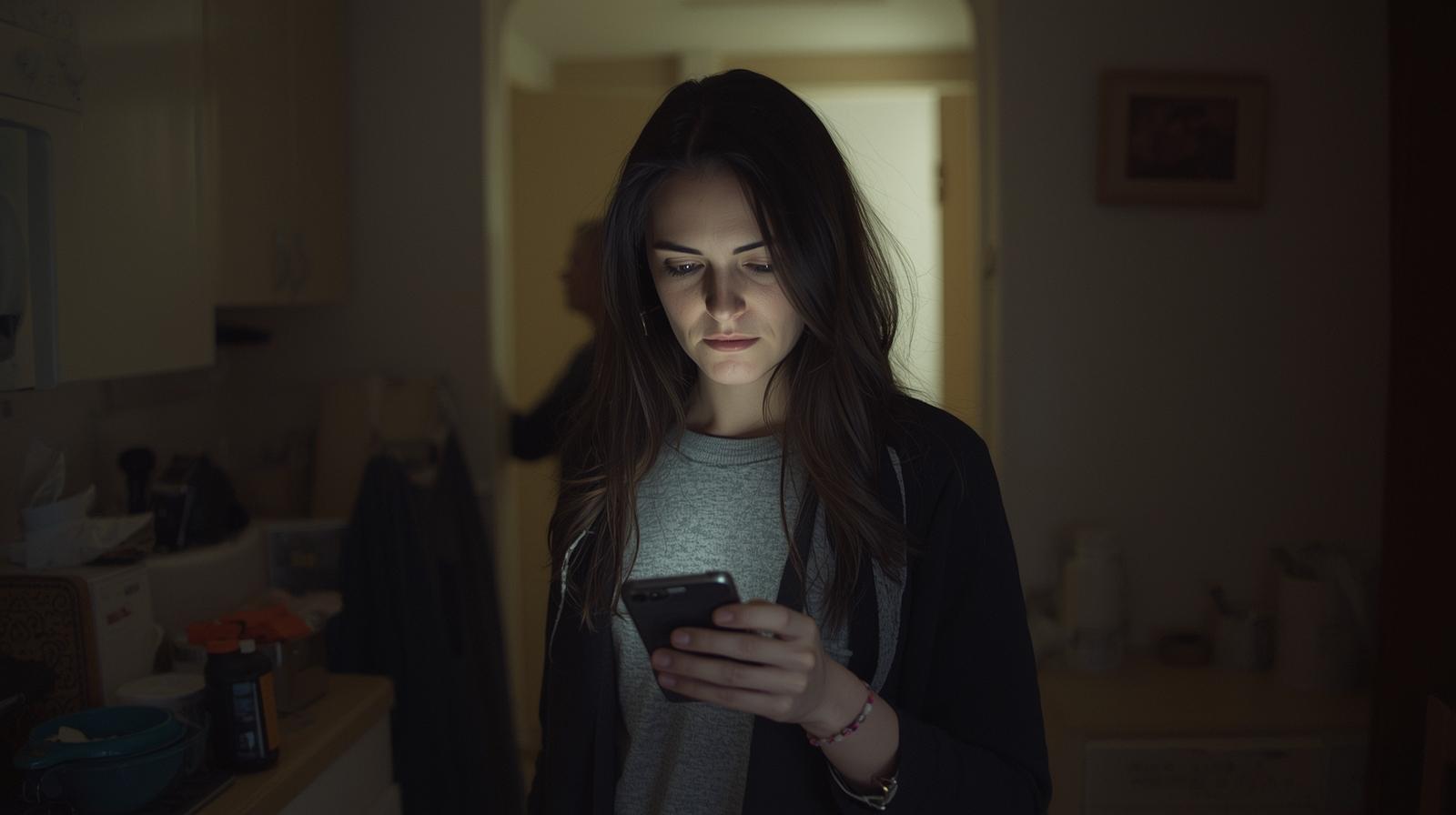
And yet you are still checking.
Still imagining.
Still waking in the night with scenes running through your head.
Still looking at him and suddenly remembering.
Early interview research into the aftermath of affairs described an initial emotional roller coaster followed by a period before trust-building became possible. :contentReference[oaicite:5]{index=5}
Recovery therefore does not necessarily happen because you made a decision.
You can decide to stay before you feel safe.
You can decide to leave before you stop loving him.
You can know intellectually that the affair has ended while your mind continues searching for danger.
If the thoughts have become repetitive, being unable to stop thinking about him cheating may be part of the injury itself rather than proof that you are making the wrong decision.
Perhaps the deepest betrayal is what happens to your certainty
Before this, you may have thought you knew your relationship.
You knew who he was.
You knew what you meant to each other.
You knew which memories belonged safely in the past.
Betrayal introduces doubt into all of those places.
That may be why recovery sometimes feels less like learning to trust another person and more like learning to trust yourself again.
Your ability to notice.
Your ability to decide.
Your ability to leave if you need to.
Your ability to survive information you wish you had never received.
The past does not have to become meaningless
This may be the strangest part.
The discovery of a betrayal does not require you to declare every previous moment false.
If you were happy on that holiday, you were happy.
If you loved him on that Tuesday morning, you loved him.
If a particular memory mattered to you, it mattered.
What you discover later can change your interpretation of a memory.
It cannot travel backwards and prevent you from having lived it.
You are allowed to keep what was real for you while changing what you believe about the person who stood beside you.
And if eventually the relationship becomes something you cannot safely continue, detaching from someone who betrayed you does not require pretending you never cared.
Sometimes letting go begins with accepting the opposite.
You cared enormously.
It mattered enormously.
And what happened still changed what you were willing to live with.
What you know now
There was a version of you who did not know.
She made choices using the information she had.
She trusted.
She believed explanations.
She may even have defended him when part of her felt uneasy.
There is no useful reason to punish her.
You know more now.
And that is the only place from which the next decision can be made.
If you are at the beginning of that decision rather than the end of it, the broader guide to what to do when your boyfriend is cheating can help you separate the immediate shock from the decisions that come afterward.
The story changed.
That does not mean you disappeared with the old version of it.
Sources
Relational recovery after infidelity as a dual process: A model based on the experiences of female injured partners
Affair recovery: Exploring similarities and differences of injured and involved partners
What determines forgiveness in close relationships? The role of post-transgression trust
Emotional processes following disclosure of an extramarital affair
Staying Together After Infidelity: An Exploration of the Decision-Making Process of Recovery From the Perspective of the Injured Partner
An integrative intervention for promoting recovery from extramarital affairs